

Marpa Lotsawa Statue – Buddhist Figure with Filigree
2.150,00 €
Skip to product information



Marpa Lotsawa Statue – Buddhist Figure with Filigree
2.150,00 €
Shipping from Germany to D: 10,00 € – see our Shipping Policy
Shipping to Germany, Switzerland, UK & USA. For other countries, please contact us below.
Question about "Marpa Lotsawa Statue – Buddhist Figure with Filigree "
Created in the workshop of Shanta Shakya in Patan, Nepal. One of a kind.
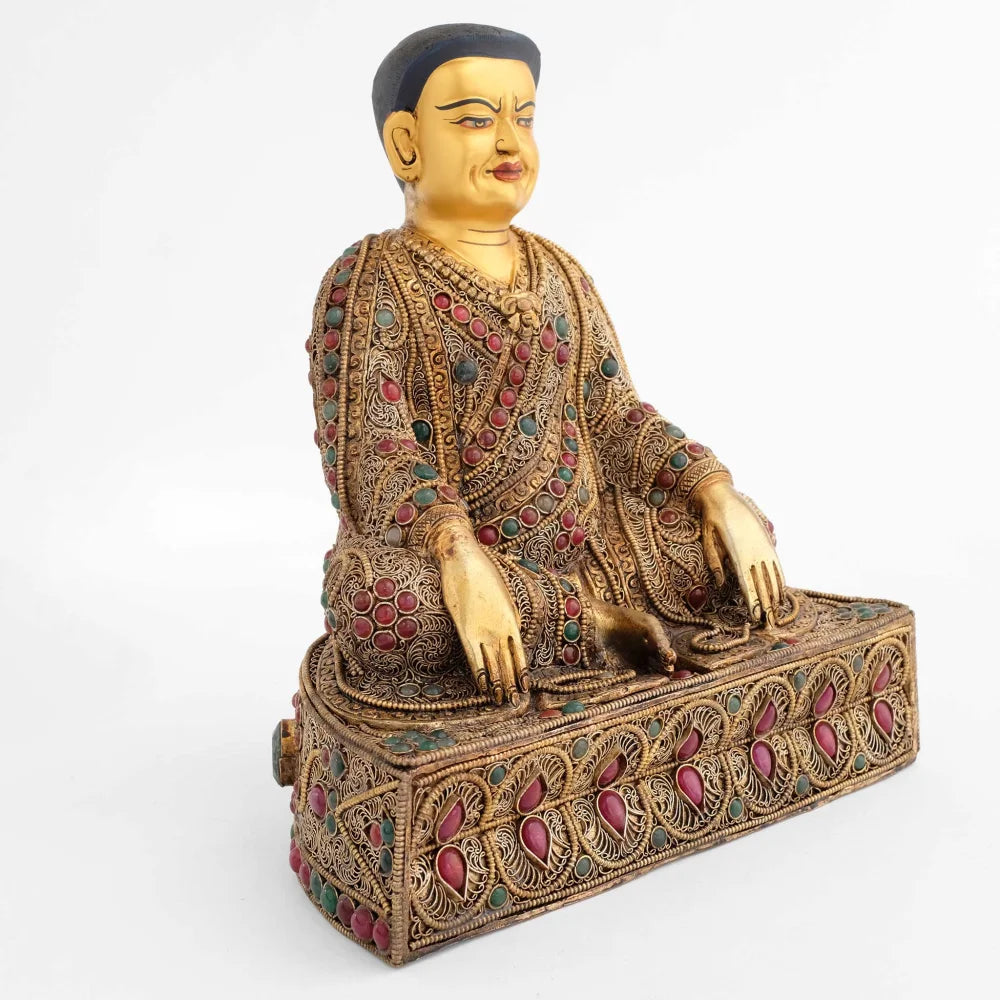
Marpa Lotsawa on a pedestal. The statue is worked in filigree, gilded and silvper-plated, set with colored stones. Guru Marpa was the founder of the Kagyu lineage and teacher of Milarepa.
Marpa, known by the title Lotsawa (translator), played a decisive role in transmitting Buddhist teachings from India to Tibet. As a direct student of Naropa, he brought important Mahamudra and Vajrayana teachings to Tibet and is regarded as the founder of the Kagyu school. As the teacher of Milarepa, he shaped the early development of this lineage.
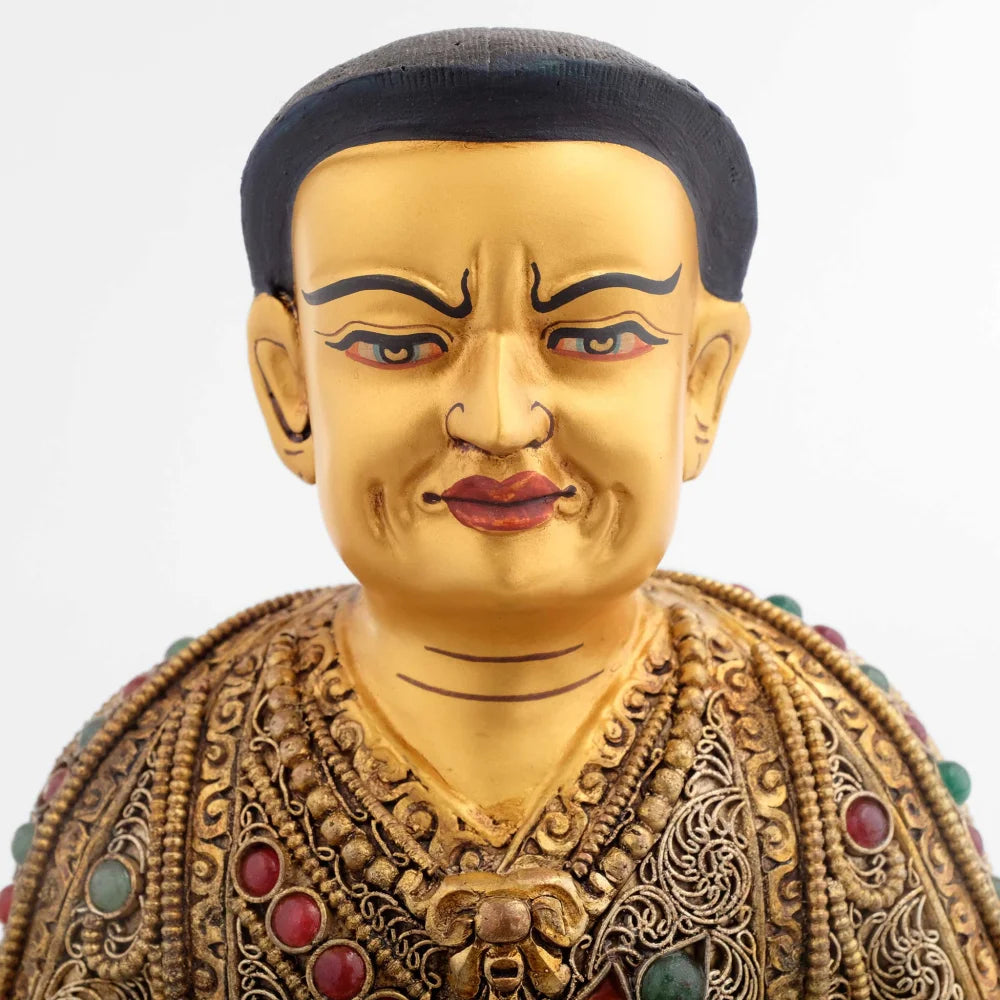
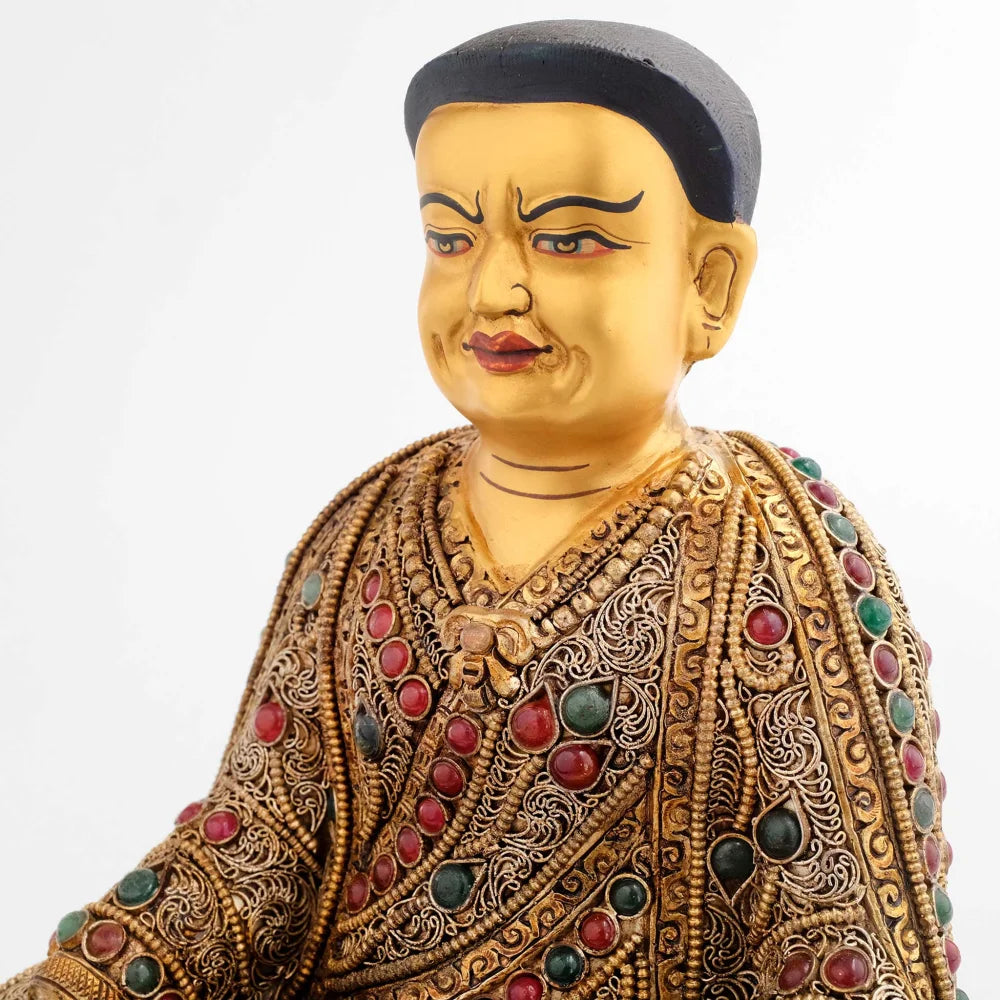
The statue depicts Marpa seated on a half-round base. His legs are loosely crossed, the hands rest over the knees, and the middle fingers touch the ground. The torso is upright, and the abdomen slightly rounded. The garment is high-collared and crossed at the front, covering the entire upper body, arms, and legs.
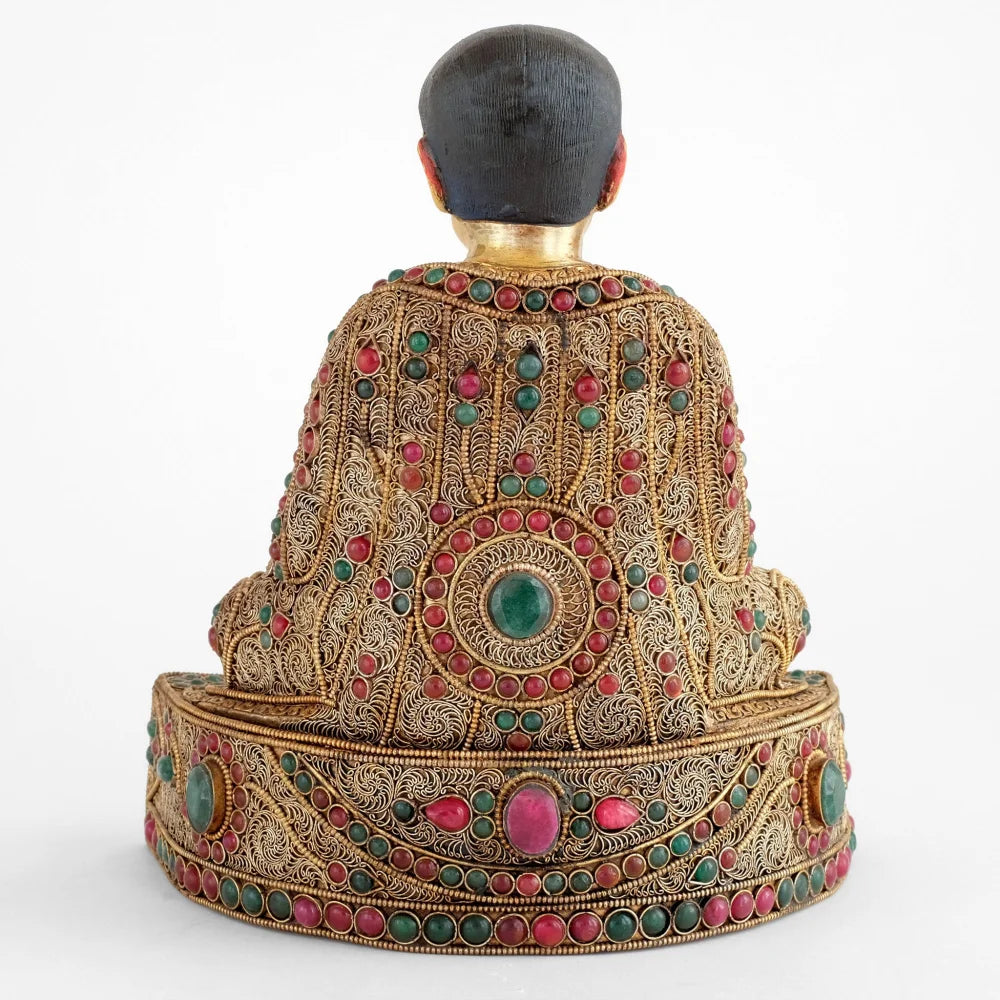
Both his garment and the pedestal are worked in filigree. Thin wires are shaped into spirals, filled with smaller arched elements, and assembled into an ornamental pattern. Colored stones accent the decoration. A central rosette marks the centre on the back of the figure.
The statue follows the image traditions of Vajrayana art in the Kathmandu Valley, in which ritual identity, gesture, and ornament are brought together into a balanced iconographic unity.
Guru Marpa
Statue made of copper, traditional lost-wax cast, filigree, gold- and silver-plated, set with colored stones. The figure is patinated. The face is set in gold. Handcrafted in Nepal.
- Height: 20,5 cm
- Width: 18 cm
- Depth: 10 cm
- Weight: 1857 g
NOTE
The face paint is a cold gold application and water-soluble.
Manufacturer information
This work was created in the tradition of Buddhist art of the Kathmandu Valley.
Manufacturer: P.B. Craft (Shanta Shakya)
Address: Nagbahal 408, Lalitpur, Nepal
Importer / Responsible Person in the EU: Yala Craft UG (haftungsbeschränkt)
Address: Jülicher Str. 72, 40477 Düsseldorf, Germany
Contact: hallo@yala-craft.com
Country of Origin: Nepal